Prioritization in nursing: which client do you assess first?
Five steps for prioritization questions: look for a threat to life, then for the client who has changed. With one worked example.
- “Assess first” asks for a client. “Do first” asks for an action.
- A threat to airway, breathing or circulation comes first.
- A new change comes before a familiar finding.
To decide which client to assess first, look for a threat to airway, breathing or circulation. If no client has one, assess the client who has changed from their own baseline. This guide gives the five steps a practical nurse can use after report, with one worked example.
What “assess first” asks for
Read the verb before you read the clients. “Assess first” and “see first” ask you to choose a client. “Do first” asks you to choose an action. They are different questions, and an answer to one does not answer the other.
This guide covers the first question: you have several clients, and you can only be in one room.
Five steps to choose the client
Work down the steps in order, and stop at the first step that separates the clients.
| Ask | How to check |
|---|---|
| 1. Is there a threat to life right now? | Airway, breathing, circulation, then level of consciousness. |
| 2. Who has changed? | Compare each client with their own baseline, not with a textbook value. |
| 3. Is the finding expected for this client? | An expected finding still needs care. It does not need you first. |
| 4. Is the problem happening now, or is it a risk? | A problem that exists now comes before one that might develop. |
| 5. What does waiting cost? | Choose the client who loses the most from a delay. |
A worked example: four clients after report
It is 07:30, and you have just had report on four clients.
- Client A is two days after a hip replacement. Pain is 6 out of 10, and a dose is due.
- Client B has COPD. Saturation is 89%, inside the ordered target, and the client speaks in full sentences.
- Client C came in yesterday with pneumonia and was alert overnight. Client C is now restless and confused, with a respiratory rate of 28. Saturation has dropped from 95% to 90% on oxygen.
- Client D has type 2 diabetes and a glucose of 9.8 mmol/L. Client D asks about discharge teaching.
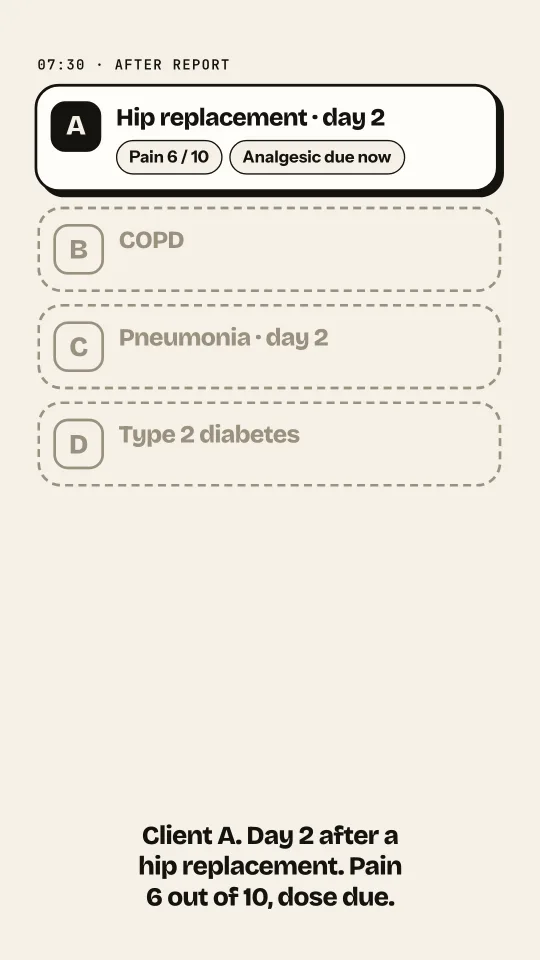
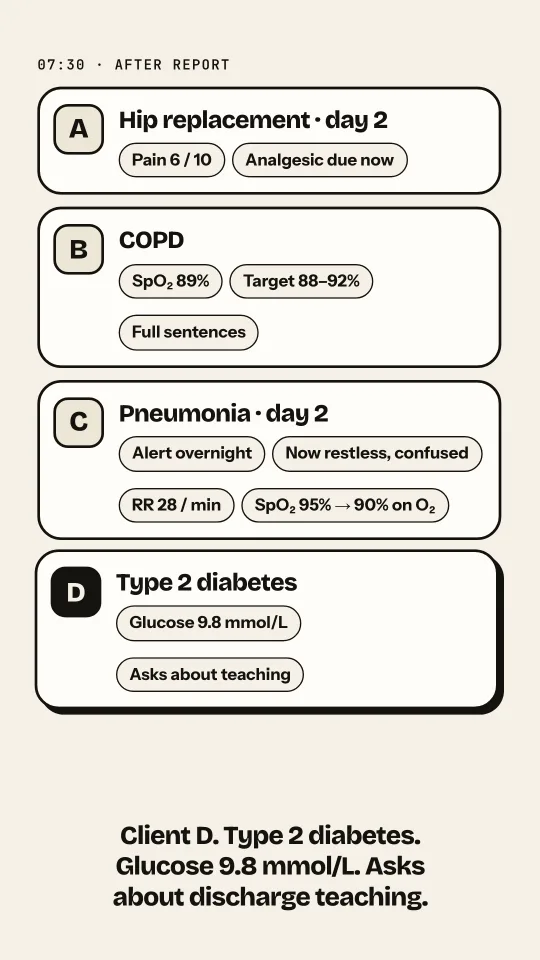
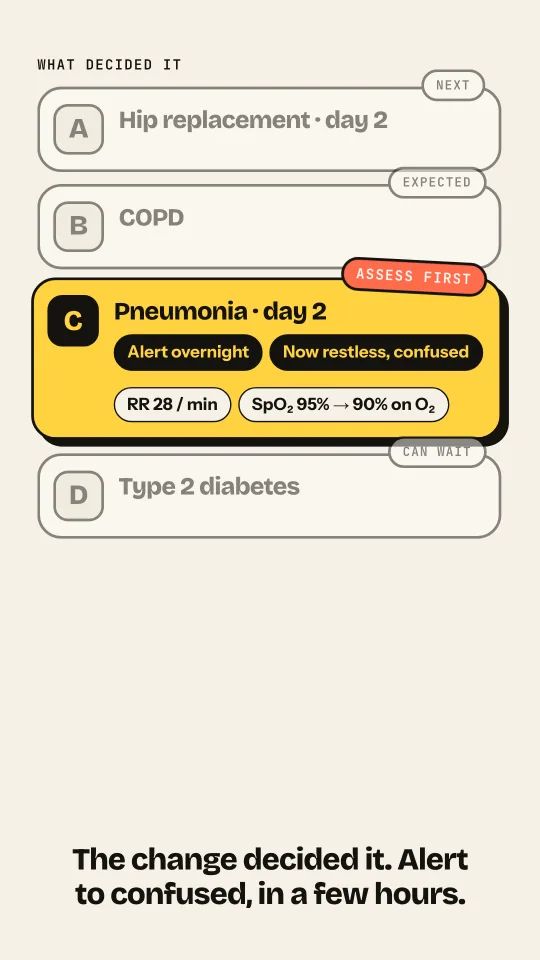
Step one separates them. Only client C has a breathing problem and a change in level of consciousness. Step two agrees, because client C is the only client who has changed. You can stop there and assess client C first.
Findings that look urgent and are not first
Three of the four clients have a finding that draws the eye. None of them comes before client C.
- Client A's pain is real and expected two days after surgery. Client A is next.
- Client B's saturation looks low, and it is where the prescriber wants it. A number inside an ordered target is the expected state.
- Client D's glucose is above target and stable. The teaching can wait.
What to do once you are with the client
Choosing the client is the start. Once you are with client C, assess, act within your role, tell the registered nurse or the prescriber, reassess, and document.
The next decision is which action to take first. That is a separate skill. See which intervention comes first.