Who can a nurse assign a task to? Three questions about the person
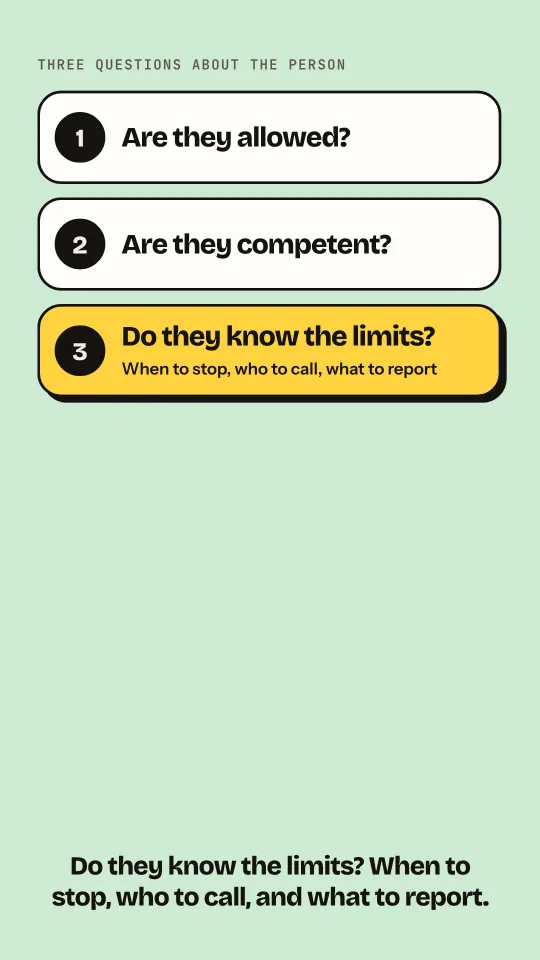
Allowed, competent, and knows the limits: three questions that tell a practical nurse which person takes an assigned task.
- Do not assume that anyone is competent.
- Competent means taught and checked on this task.
- Three yeses, or you choose again.
Assign a task to a person who is allowed to do it, who has been taught and checked on it, and who knows when to stop and call you. If one answer is “no”, choose someone else, or do the task yourself. This guide works through the three questions on one example.
Do not assume that a person is competent
You have a task that is safe to assign, and more than one person could take it. You cannot assume that anyone is competent, however simple the task looks. Years on the unit do not answer the question, and a job title does not either.
Three questions about the person
| Ask | What a “yes” needs |
|---|---|
| 1. Are they allowed? | The task is in their role description and in your employer's policy. |
| 2. Are they competent? | Someone taught them this task and checked that they can do it. |
| 3. Do they know the limits? | They know when to stop, who to call, and what to report. |
A worked example: three people, one task
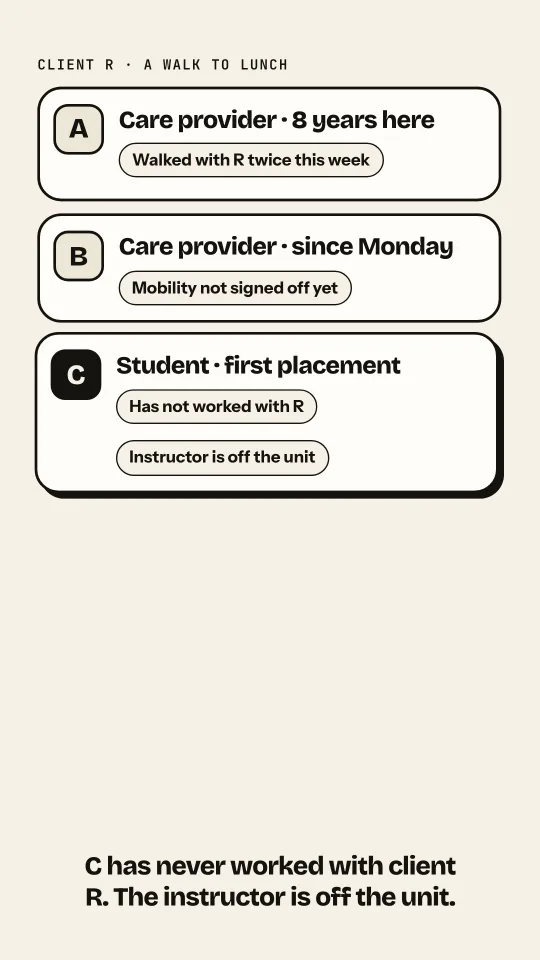
Client R is stable, and walks with a walker and a transfer belt. Client R needs to get to the dining room for lunch. Three people could take the task.
- Care provider A has worked on this unit for eight years, and walked with client R twice this week.
- Care provider B started on Monday. Mobility is still unsigned on the orientation record.
- C is a practical nursing student on a first placement. C has never worked with client R, and the instructor is off the unit.
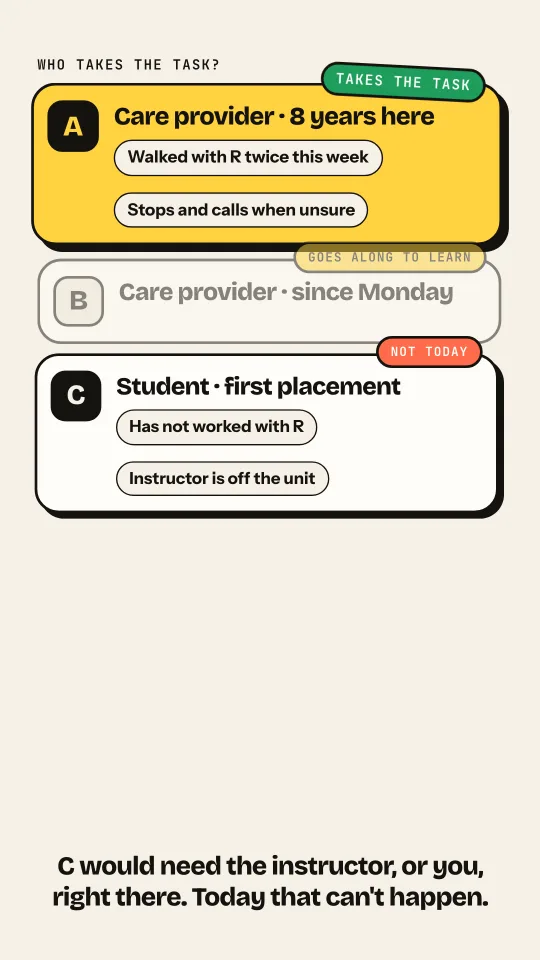
Who takes the task, and why
Care provider A takes the task. A is allowed, and has shown the skill with this client. A also knows to stop and call you if client R gets dizzy.
B is allowed by the role. Nobody has checked the skill yet, so B does not walk client R alone. B can go along with A, and learn.
C would need the instructor, or you, right there. Today that cannot happen, so C does not take the task.
After you choose the person, your words decide if the client stays safe. See how to give a clear instruction and follow up.