Assigning a task: how to give a clear instruction and follow up
The four parts of a clear instruction to an unregulated care provider, and what a practical nurse checks afterwards.
- Name the client, the task and its limits.
- Name the findings that mean “stop, and call”.
- A reported finding needs your own assessment.
A clear instruction names the task and its limits, the time, the findings to report at once, and when to report back. After you assign a task, you follow up, because the client is still yours. This guide shows both steps on one example.
The four parts of a clear instruction
“Keep an eye on client V” tells a care provider almost nothing. A clear instruction has four parts.
| Part | What you say |
|---|---|
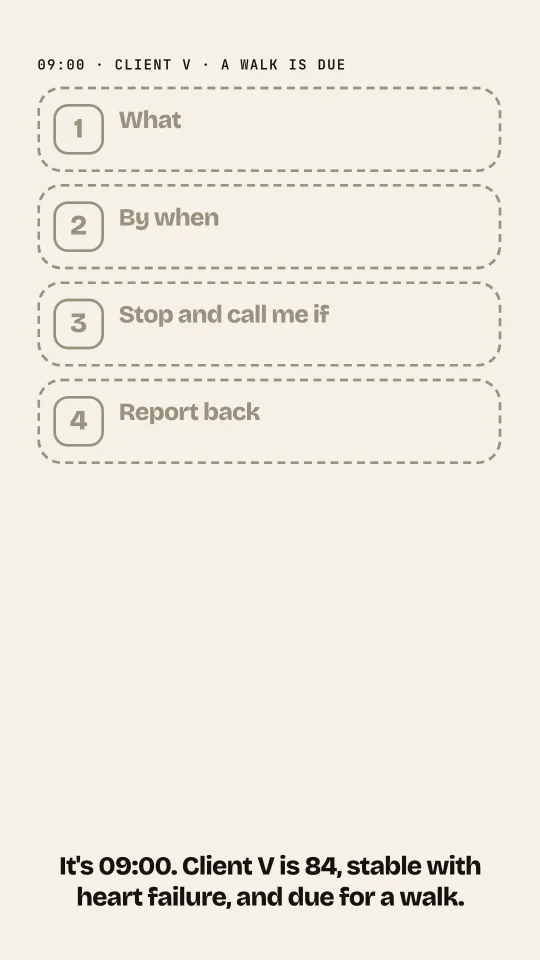
| 1. What, exactly | The client, the task and its limits. |
| 2. By when | The time the task must be done. |
| 3. What to tell you at once | The findings that mean “stop, and call”. |
| 4. When to report back | The time, and what you want to hear. |
A worked example: client V's walk
It is 09:00. Client V is 84, stable with heart failure, and due for a walk. You say:
- “Please walk client V to the end of the hall and back, with the walker, before 10:00.”
- “Stop and call me at once if client V is dizzy, short of breath, or has chest pain.”
- “When you are back, tell me how far client V walked.”
Follow up, because the client is still yours
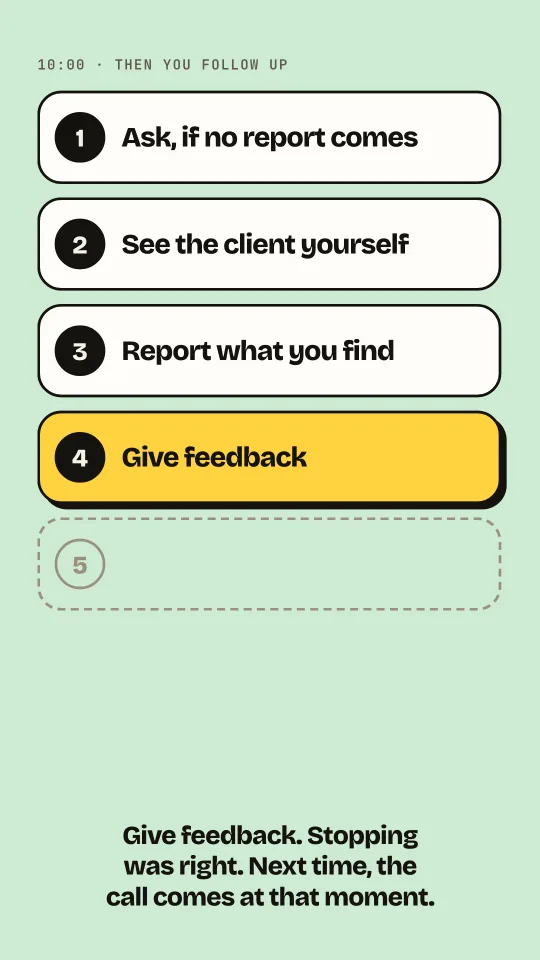
At 10:00 nobody has reported, so you go and ask. The care provider says they got halfway. Client V seemed winded, so they came back.
That is a finding, and assessing it is your job. See client V yourself. Check the breathing and the vital signs, and report what you find.
Give feedback and document
Then give feedback. Stopping was right. Next time, the call comes the moment it happens. Document what you assessed, and what you did.