Priority nursing interventions: what do you do first?
Order your interventions by how fast a problem can worsen and by what is around the client. With a worked example of four clients.
- Ask how fast the problem can get worse.
- Early signs come before the numbers move.
- Using the team is part of setting priorities.
When several clients need you in the same half hour, do first the intervention for the problem that can get worse fastest. Then use what is around the client, such as hazards and the people on the unit, to order the rest. This guide shows the questions to ask, with one worked example.
Two things decide what you do first
Two things decide the order of your interventions: how the condition behaves, and what is around the client. Start with the condition, and then look around the client.
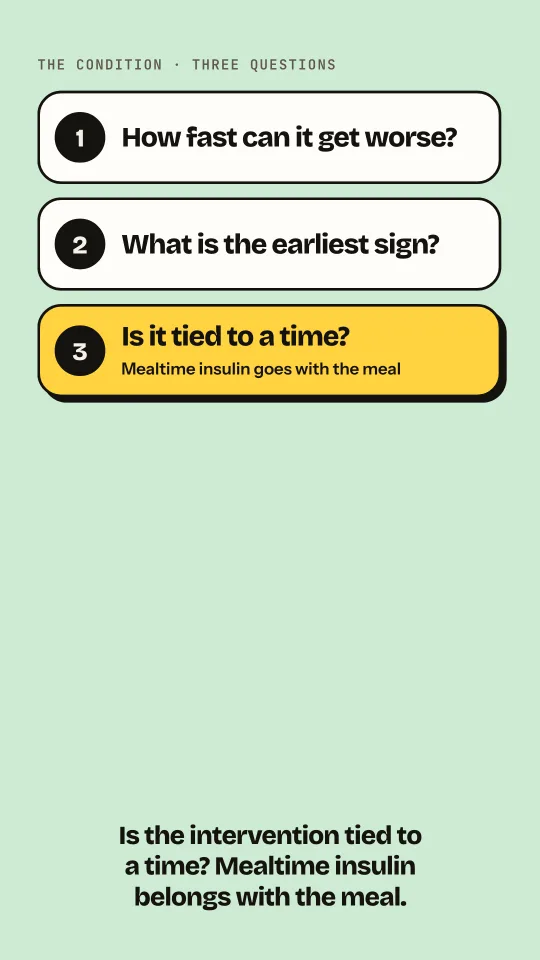
Three questions about the condition
- How fast can this get worse: in minutes, or in days?
- What is the earliest sign? Restlessness, new confusion and a rising respiratory rate often come before the numbers on the monitor move.
- Is the intervention tied to a time? Mealtime insulin belongs with the meal.
What is around the client
| Look at | Ask |
|---|---|
| Hazards | Is someone about to fall or be harmed? |
| People | Who is on the unit, and what are they allowed to do? |
| Place | How far away is help? |
| Infection risk | Use it when nothing else separates two tasks. |
A worked example: four clients at 11:45
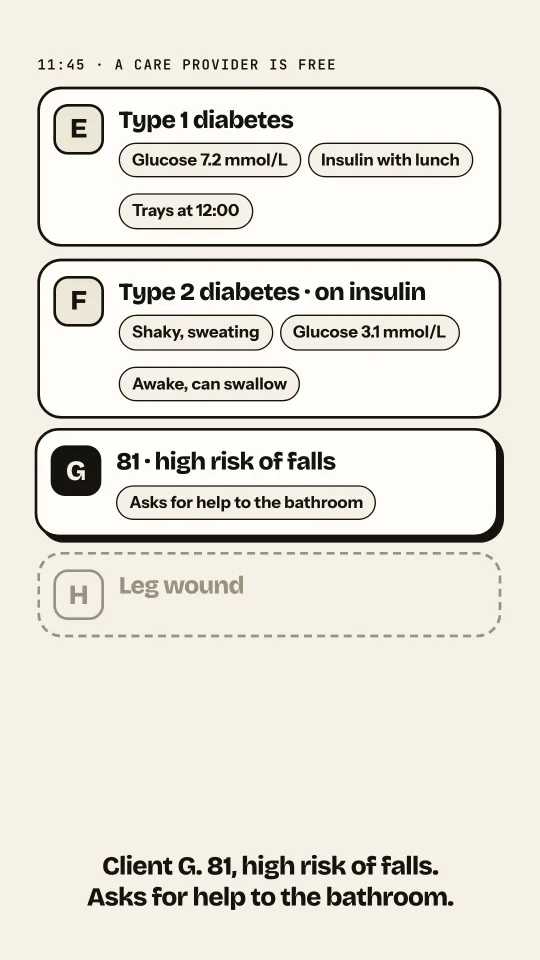
It is 11:45, and an unregulated care provider is free.
- Client E has type 1 diabetes. Insulin is ordered with lunch, and the trays come at 12:00.
- Client F is on insulin, shaky and sweating, with a glucose of 3.1 mmol/L. Client F is awake and able to swallow.
- Client G is 81, at high risk of falls, and asks for help to the bathroom.
- Client H needs a dressing change this shift.
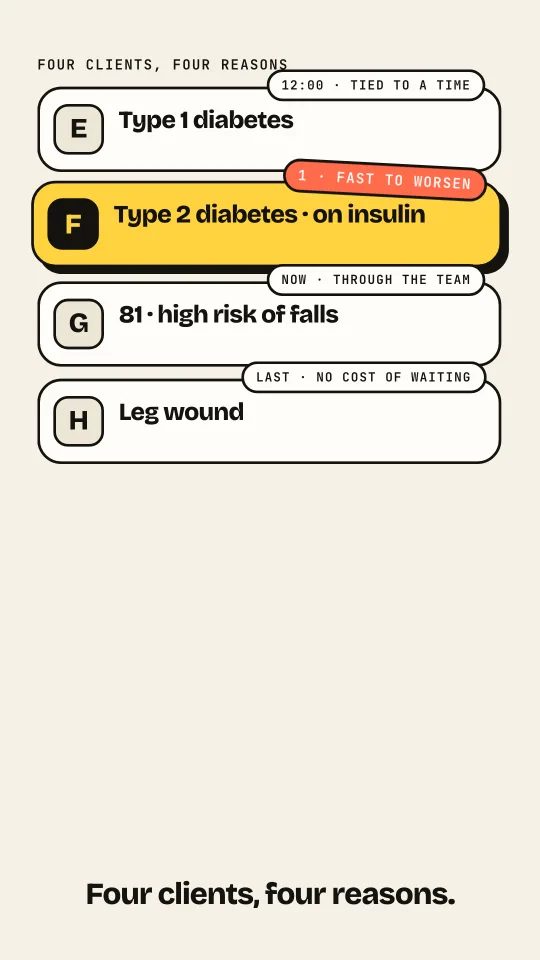
Client F comes first. A low glucose with symptoms can worsen within minutes. Follow your hypoglycemia protocol, and then retest.
Client G cannot wait either, so you ask the care provider to help client G now. Using the team is part of setting priorities. Client E comes next, at 12:00, because the insulin becomes the priority when the tray arrives. Client H is last, because that wound will be the same in an hour.
Four clients, four reasons
- Client F: the problem is fast to worsen.
- Client G: there is a hazard, and help is nearby.
- Client E: the intervention has a fixed time.
- Client H: waiting costs nothing.