Nursing handoff report: four parts in order, then ask and read back
Give every handoff report in the same order: who, now, done, next. Then the nurse who receives it asks about gaps and reads back what is pending.
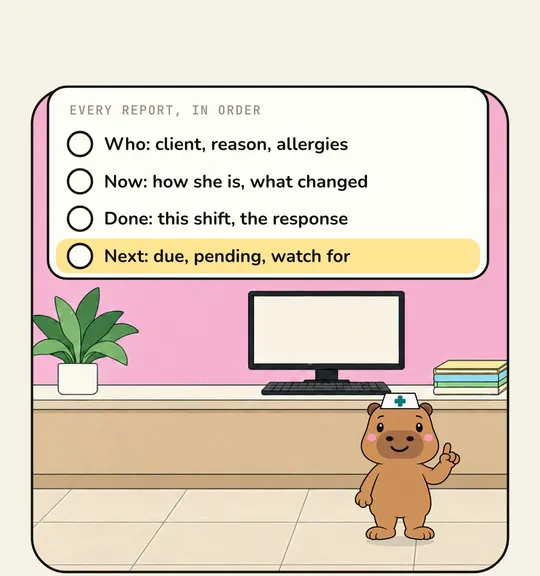
- Every report has four parts: who, now, done, next.
- Say what is pending, and who is waiting for it.
- When you receive a report, ask about any gap, then read back what is pending.
A safe nursing handoff report follows a fixed order: who the client is, how the client is now, what was done this shift, and what comes next. The nurse who receives it asks about any gap and reads back what is pending. This guide follows one report that nearly left out a blood result.
Loose facts lose things
It is 07:00. The night nurse has her coat on. About client S, she says: “She's fine. You don't need to worry about the blood.” You get one question before she goes.
A report given as loose facts loses things. A fixed order keeps them, because the order asks for each part. Nobody has to remember.
The four parts of every report
| Part | What it holds |
|---|---|
| Who | The client, the reason for care and any allergies. |
| Now | How the client is, and what has changed. |
| Done | What was done this shift, and how the client responded. |
| Next | What is due, what is still pending and what to watch for. |
Client S, in order
So the night nurse puts her bag down and gives the report again, in order.
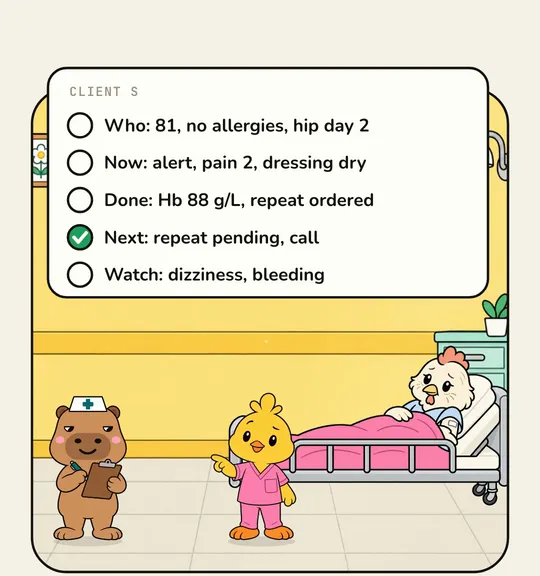
- Who: client S is 81, has no allergies and is two days after hip surgery.
- Now: she is alert, her pain is 2 out of 10 and her dressing is dry.
- Done: her hemoglobin was 88 g/L this morning. The nurse told the prescriber, who ordered a repeat.
- Next: the repeat is not back, and the prescriber wants a call with the result. Watch for dizziness and for bleeding at the dressing.
When you receive a report: ask, then read back
Use the four parts as a checklist while you listen. When a part is missing or vague, ask about it. Here, you ask when the sample was taken. The answer is 04:00.
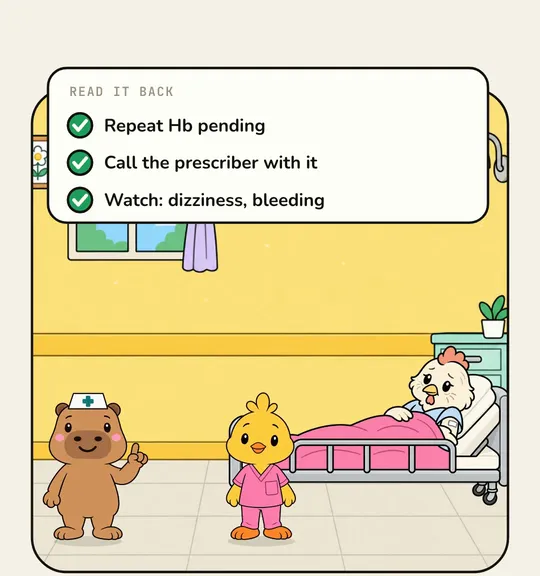
Then read back what is pending before the other nurse leaves:
- Repeat hemoglobin pending.
- Call the prescriber with the result.
- Watch for dizziness and bleeding.
The read-back catches what you misheard. Now you both hold the same picture.
After the report
A report is a starting point. Go and see your clients, and act on what you find. To choose who to see first, see which client to assess first.
Your agency may use a named handoff tool. The skill under every tool is the same: a fixed order, then a read-back. What is still open at the end of a shift also goes in the chart. See what to chart so the next nurse can act.