Nursing documentation: what to chart so the next nurse can act
Chart what you saw, what you did and how the client responded, with the times. Avoid vague labels and short forms with two meanings.
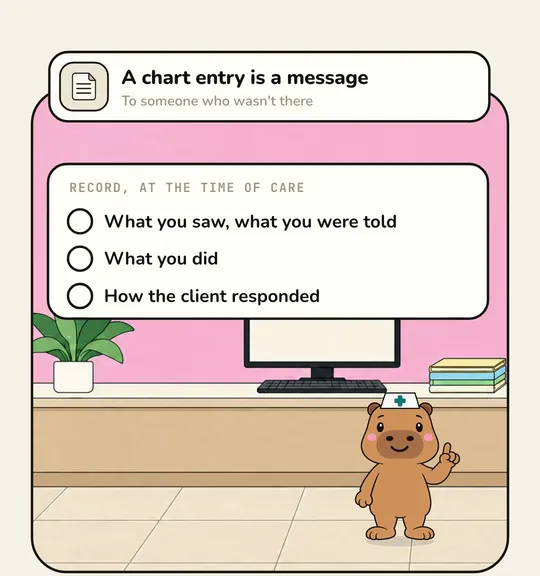
- A chart entry is a message to someone who was not there.
- Record what you saw, what you did and how the client responded, at the time of care.
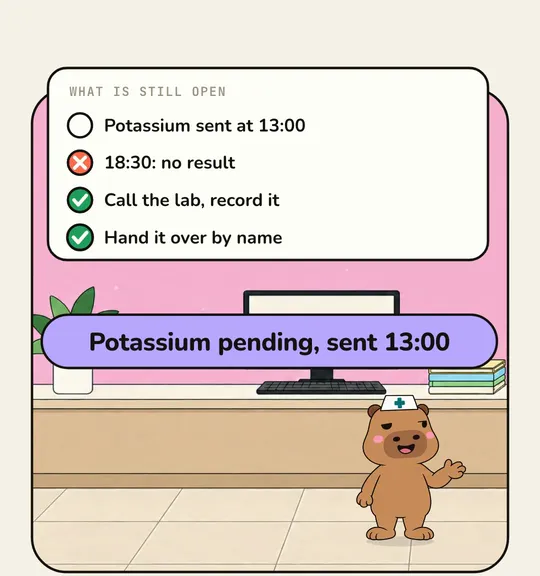
- What is still open, you follow up, record and hand over by name.
Good nursing documentation records three things at the time of care: what you saw and what the client told you, what you did, and how the client responded. Then the next nurse can act on it. This guide reads three chart entries for one client and follows one result that is still open.
A chart entry is a message
A tired colleague says: “Just write ‘bad afternoon’. Nobody needs the details.” Now it is 18:30. Your shift has just started, and that entry is what you read. Can you act on it?
A chart entry is a message to someone who was not there. So it must hold what that person needs to act.
Record three things at the time of care
- What you saw, and what the client told you.
- What you did.
- How the client responded.
Give the times. Use the terms that your agency approves.
Three entries for client T
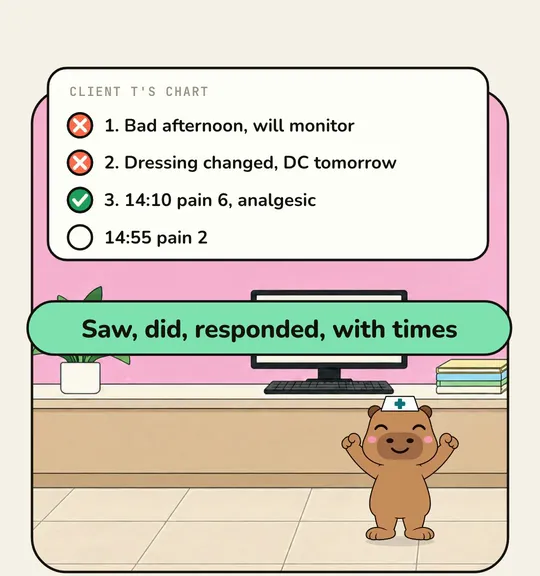
Client T's chart has three entries from this afternoon. Only one of them lets the reader act.
| Entry | Can the next nurse act on it? |
|---|---|
| “Had a bad afternoon, will monitor.” | No. It has no finding, no action and no response. Monitor what? |
| “Dressing changed, DC tomorrow.” | No. “DC” can mean discharge or discontinue. The reader has to guess. |
| “14:10 knee pain 6/10, analgesic given as ordered. 14:55 pain 2/10.” | Yes. What the nurse saw, what she did and how he responded, with the times. |
Follow up what is still open
Then ask what is still open. A potassium sample went to the laboratory at 13:00. At 18:30, the chart has no result.
Do not wait for a result to find you. Look for it: call the laboratory, and record what they tell you. Then hand it over by name: “Potassium pending, sent at 13:00.”
A pending result also belongs in your verbal report. See how to give a handoff report.
Check your last entry
Read your last entry again. Could the next nurse act on it? If not, add the finding, the action and the response. Saw, did, responded. What is open, you follow up and pass on.
Clear entries also help the next nurse judge if the plan is working. See evaluating the plan of care. Documentation standards differ by province and by employer. Follow your regulator's standards and your agency's policy.