Advance directives in nursing: whose words does the team follow?
A capable client's words today come first. When a client can't decide, the person they named or the person the law lists speaks.
- While a client can decide, their words today come first, ahead of any paper.
- The person a client named speaks for them, and must follow their wishes.
- No paper does not mean no decision-maker. The law lists who speaks.
An advance directive speaks for a client only when the client can't decide. While a client is capable, what the client says today comes first, ahead of anything written. This guide follows three clients and shows whose words the team follows for each one.
Whose words does the team follow?
| Client | Who decides | Your part |
|---|---|---|
| Capable today, with an old paper | The client, in his own words today | Tell the prescriber what he says now. |
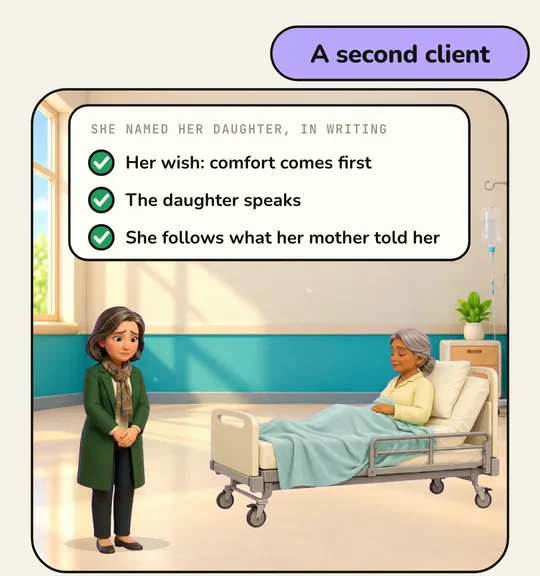
| Can't decide, and named her daughter in writing | The daughter, who must follow her mother's wishes | Find out who was named and what was wished. |
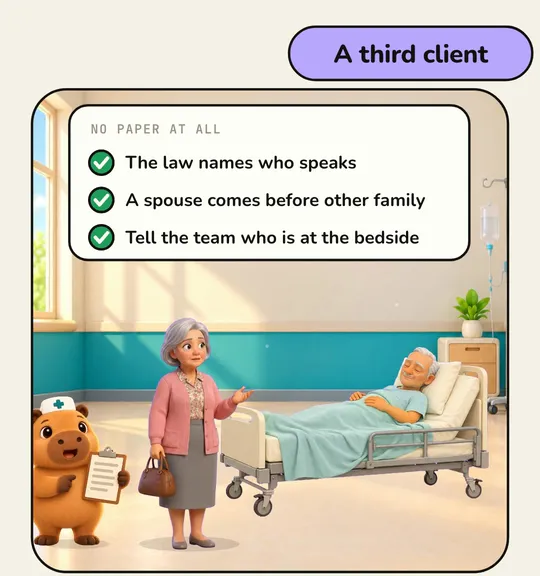
| Can't decide, with no paper | The person the law lists. A spouse comes before other family. | Tell the team who is at the bedside. |

A capable client's words today come first
A colleague says at the desk, “He wrote no dialysis two years ago. Don't ask him again, just follow the paper.” But your client can decide today, and this morning he told you, “I've changed my mind. I want to try it.”
A capable client's own words today come first, ahead of any paper. So you tell the prescriber what he said, so that the plan and the paper catch up.
A client who can't decide: the person they named
For a client who can't decide today, the next question is who speaks for them. It is the person they named, or the person the law lists.
Your second client can't decide. She named her daughter in writing, and she told her daughter that comfort comes first. So the daughter speaks, and she must follow what her mother told her.
No paper: the law lists who speaks
Your third client can't decide either, and he has no paper at all. His wife visits every day. No paper does not mean no decision-maker. The law names who speaks, and a spouse comes before other family. So you tell the team who is at the bedside.
The papers have different names in each province
- Ontario: a power of attorney for personal care names a decision-maker.
- British Columbia: a representation agreement names a decision-maker, and an advance directive holds the written instructions.
Choosing the decision-maker belongs to the provider who proposes the treatment. Your part is to find out, and to report. Follow the law of your province and your agency's policy.
The next step is to get the wishes into the record. See advance care planning in nursing. For consent from a decision-maker, see substitute decision-maker consent.