Continuing competence for nurses: what to do when you find a gap
Your client comes first. Then name the gap, set a goal with a date, choose activities and check. Your regulator expects it every year.
- When you find a gap, your client comes first. Say so, and get help.
- A learning goal says what you will be able to do, and by when.
- Your regulator expects you to check your competence every year.
Continuing competence means that you check your own practice every year, find your gaps and make a plan to close them. When you find a gap at work, your client comes first: say so and get help, then plan the learning. This guide follows one practical nurse who meets a feeding pump that she has never used.
A pump you have never seen
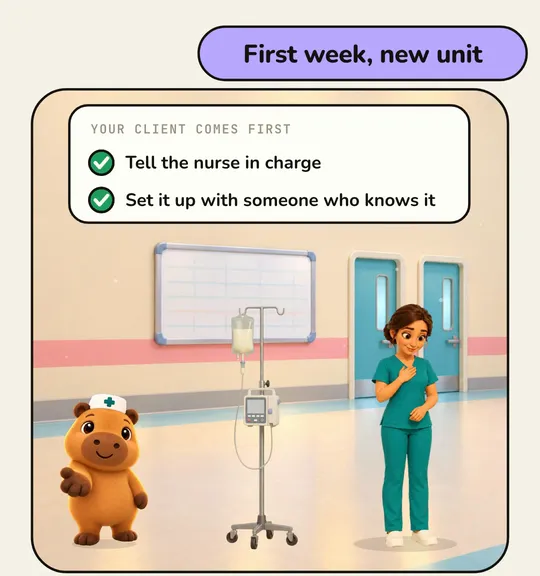
It is your first week on a new unit. A client needs a tube feed started at 10:00, and the feeding pump is a model you have never seen. A colleague says, “It's easy, you'll work it out. Nobody needs to know you've never used it.”
Your client comes first
You do not work it out alone. You tell the nurse in charge, and you set up the feed with a colleague who knows this pump. Then you plan the learning.
Make a learning plan
| Part | Example |
|---|---|
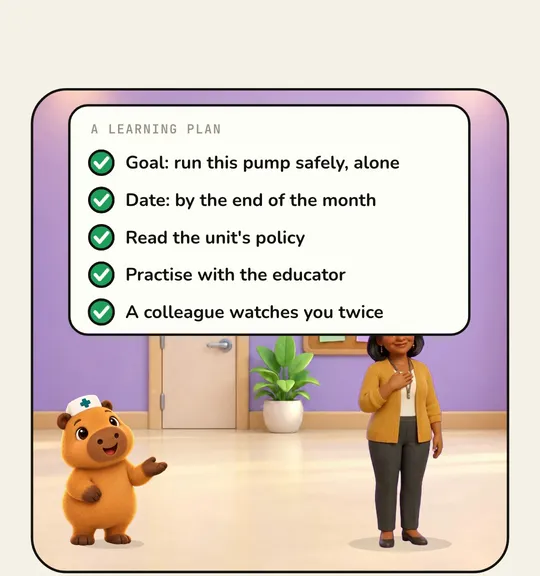
| The gap | You can't yet set up and run this pump safely. |
| A goal with a date | By the end of the month, you will set up and run a feed on this pump, safely and without help. |
| The activities | Read the unit's policy, practise with the educator, and ask a colleague to watch you twice. |
| The check | Ask for feedback. Ask yourself what you now do differently. |
Then record the plan the way your regulator asks.
Competence is something you keep up
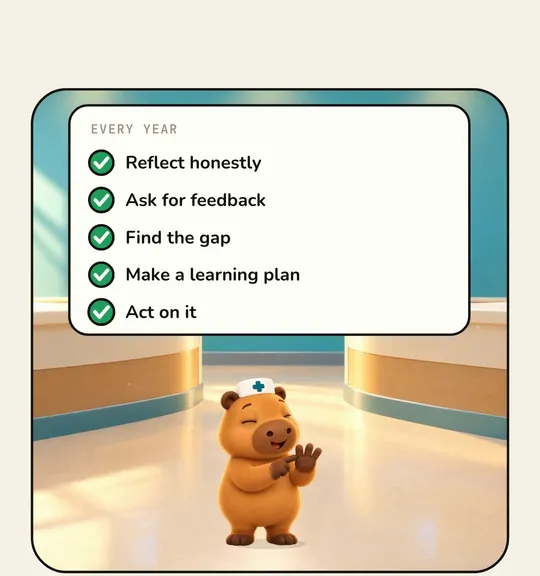
Your regulator expects you to check your competence every year. Use the same five steps each time.
- Reflect honestly on your practice.
- Ask for feedback.
- Find the gap.
- Make a learning plan.
- Act on it.
Learning is complete when your care has changed. Each regulator has its own way to record the plan, so follow yours.
Competence is also one of the three questions of scope of practice. This lesson is one part of ethical issues and advance directives in nursing.