Ethical dilemmas in nursing: how to tell a dilemma from a hard moment
A dilemma is two values that pull apart, with no rule to settle it. Three questions sort a hard moment from a real dilemma. With three examples.
- If a rule answers it, it is not a dilemma. Follow the rule.
- A dilemma is two things you value that point to different actions.
- Name both values, then take them to the client and the team.
An ethical dilemma in nursing is a situation where two things you value point to different actions, and no rule settles it. Many hard moments are not dilemmas, because a rule answers them. This guide follows one practical nurse through three moments on one shift and sorts them with three questions.
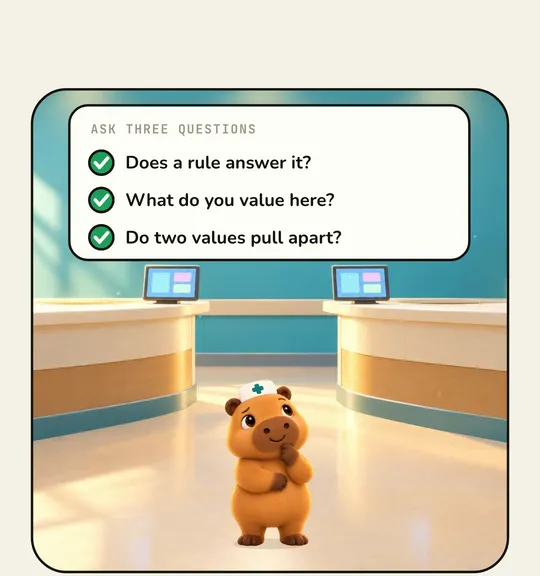
Three questions for anything that troubles you
Ask the questions in order. The first question often ends the search.
| Ask | What the answer tells you |
|---|---|
| 1. Does a rule answer it? | If yes, follow the rule. It is hard, but it is not a dilemma. |
| 2. What do you value here? | Name each value, for example the client's choice or the client's safety. |
| 3. Do two of those values pull apart? | If yes, it is a dilemma. Name both values, and take them to the client and the team. |
Vital signs you did not take: a rule answers it
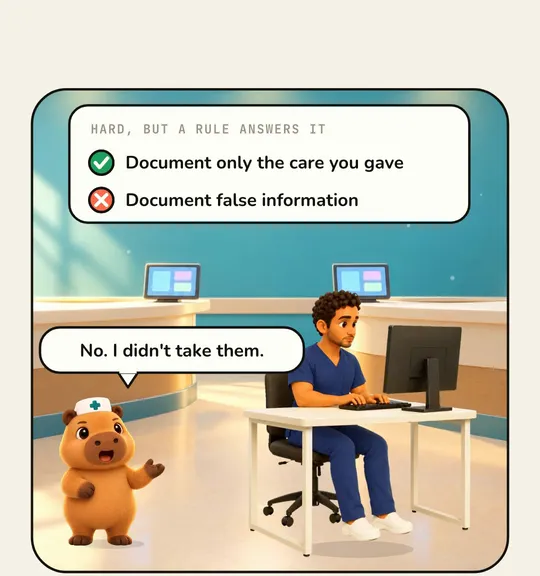
At the end of a long shift, a colleague asks you to chart his client's vital signs. “I'm sure they were fine, and nobody checks.” You did not take those vital signs, and the request makes you uncomfortable.
It is hard, but it is not a dilemma, because a rule answers it. You document only the care you gave, and you never document false information. So you say no, and your colleague takes the vital signs himself.
A judgment about how a client lives: a rule answers it
Later, another colleague says that a client who drinks heavily can wait for his pain medication. That has a rule as well. A judgment about how a client lives never decides his care. So you speak up, and the client gets his medication on time.
Client K: two values pull apart
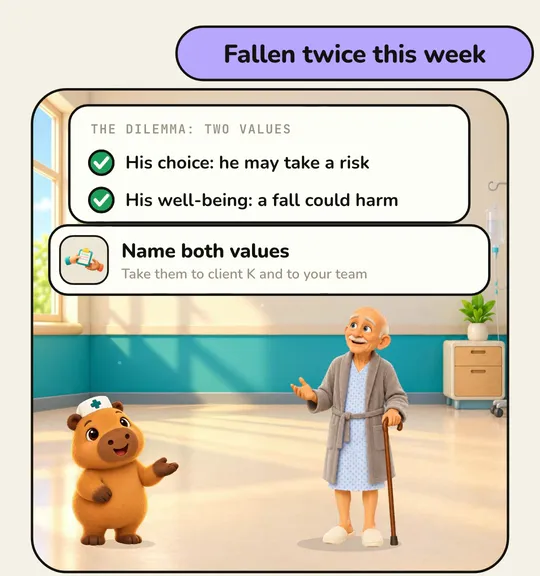
Client K is capable, and he has fallen twice this week. He tells you, “I'm walking to the bathroom alone. I'm not a child.”
This one is the dilemma, because two things you value point to different actions.
- His choice: a capable client may take a risk.
- His well-being: another fall could do real harm.
So you name both values. Then you take them to client K and to your team, to look for a plan that respects both. You do not overrule the client, and you do not walk away.
A family that asks you to keep a diagnosis from a capable client needs a different skill. See how to act on an ethical concern. For the whole story, read ethical issues and advance directives in nursing.