The nurse's role in informed consent: check, hold and call back
The provider who proposes a treatment explains it. The nurse checks understanding, holds, calls them back, and gets consent for their own care.
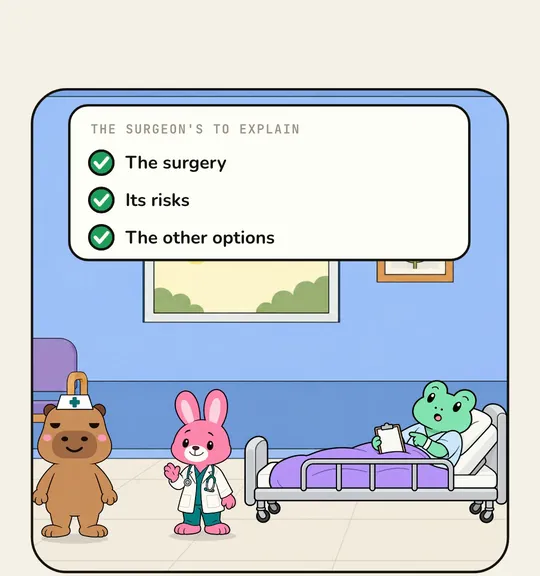
- The provider who proposes a treatment explains it, with its risks and the other options.
- Use the interpreter service for a consent discussion, not a relative.
- For your own care, you get the consent, and you stop on a no.
The nurse's role in informed consent depends on whose treatment it is. For another provider's treatment, you check what the client understands, stop when there is a gap, and call that provider back. For your own care, the consent is yours to get. This guide follows one client before surgery.
“I signed, but I don't know what they will do”
At half past eight you come to give the premedication before surgery. Your client says, “I signed the form, but I don't really know what they are going to do.”
The premedication is due now, and it will make your client drowsy. A drowsy client cannot take part in a new explanation, so you hold it.
Call the provider back
Ask what your client understands and what is still unclear. Then call the surgeon back. Explaining the surgery, its risks and the other options belongs to the provider who proposed it.
Do not fill that gap yourself. You can help your client get the questions ready.
Use the interpreter service
Your client speaks Vietnamese at home, and the leaflet at the bedside is in English. So you ask for the interpreter service, and for the leaflet in Vietnamese if your agency has one.
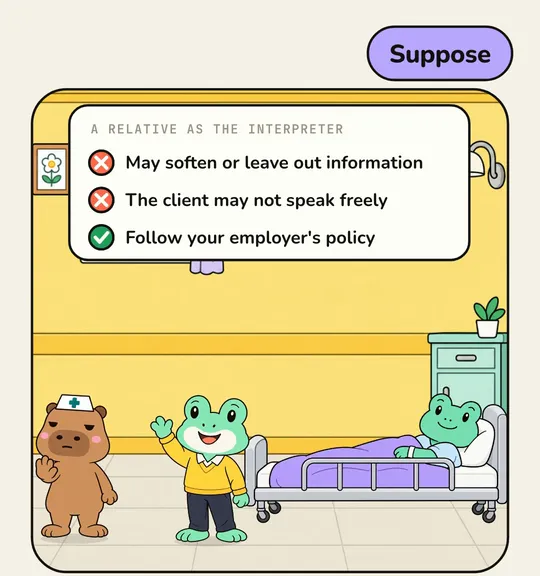
Now suppose the client's son offers to interpret. A relative may soften or leave out information, and your client may not speak freely in front of family. So you follow your employer's policy and use the interpreter for a consent discussion.
Then tell the nurse in charge, and document what your client said and whom you told.
Consent for the care that you give
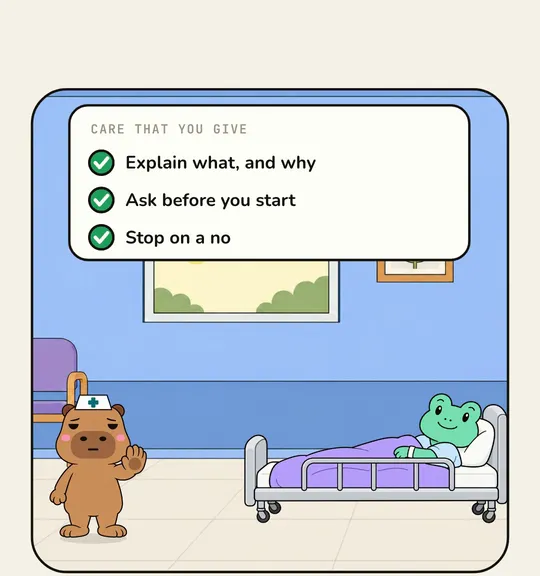
Later the care is your own, so the consent is yours to get.
- Explain what you are about to do, and why.
- Ask before you start: “May I go ahead?”
- Stop on a no, even when the no is a hand pushed away.
Consent and interpreter policies differ between provinces and between employers. Follow your regulator and your agency's policy. See what makes consent valid, or read the whole topic.