A client's right to refuse treatment: what the nurse does
A capable client has the right to refuse treatment. Never hide a medication in food. Ask why, inform, respect the answer, then report and document.
- Hiding a medication in food is a trick. Do not do it.
- Ask why, inform, and respect the answer without arguing.
- Report the refusal and the reason, document, and keep assessing.
A capable client has the right to refuse treatment, so the nurse asks why, gives the information, and respects the answer. Then the nurse reports the refusal to the prescriber and documents it. A medication is never hidden in food. This guide follows one client with heart failure.
“Just mix it into his food”
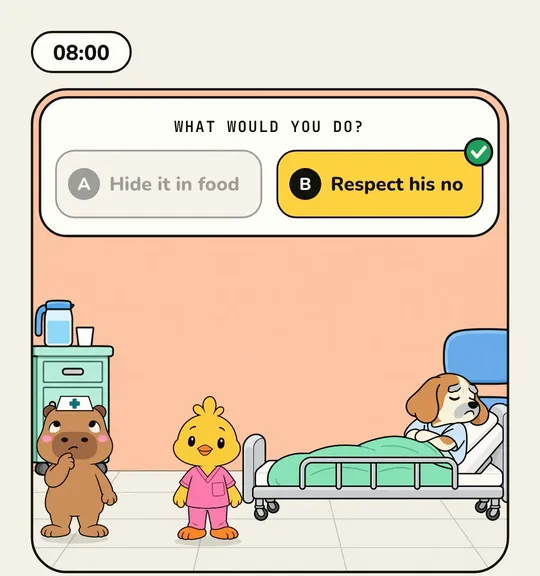
At eight o'clock your client with heart failure pushes away his morning diuretic. He tells you, “I'm not taking that, and I'm not going for that heart test either.” A colleague says, “Just mix it into his food, he'll never know.”
Your client is capable, and a capable client has the right to refuse. Hiding a medication in food is a trick, so you say no to that.
Ask why, and listen
Start by asking why, with something like, “Tell me what worries you about it.” Then listen. The diuretic keeps him in the bathroom all morning, and nobody has told him what the heart ultrasound at eleven is for.
Tell him what each treatment is for
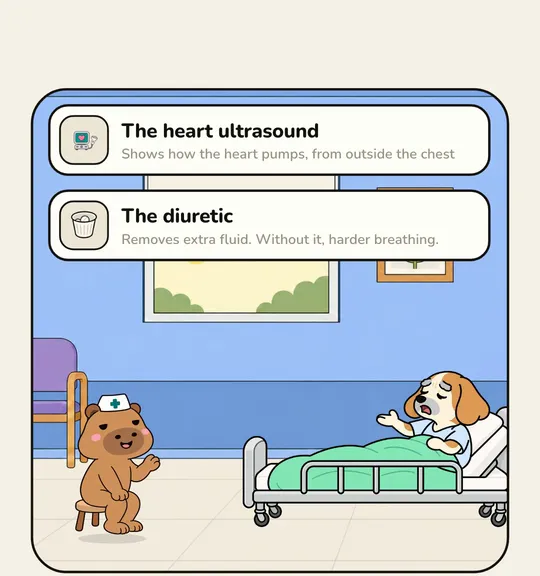
| Treatment | What you tell him |
|---|---|
| Heart ultrasound | It shows how well the heart is pumping, from outside the chest. |
| Diuretic | It removes extra fluid. Without it, his breathing may get harder. |
Respect the answer
He now agrees to the ultrasound. He still refuses the diuretic this morning. You respect that without arguing, bargaining, or asking again and again.
Report it and document it
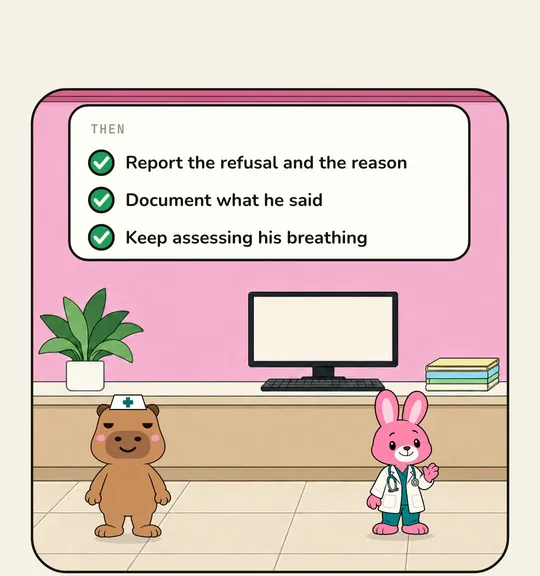
- Report the refusal and the reason to the prescriber, who can discuss other options with him, such as a different time.
- Document what he said and what you did.
- Keep assessing his breathing.
Clear yesterday, confused today
Now suppose he was clear yesterday and is confused this morning. That is a change in your client and more than a refusal. So you assess him and report it, and you still do not force the medication.
Consent and refusal laws differ between provinces. Follow your regulator and your agency's policy. A refusal in one shift with health records and interpreting is in records, interpreting and the right to refuse. See also the whole topic.