Health records, interpreting and the right to refuse treatment
Three legal duties in one shift: who may open a health record, when a nurse may interpret, and what to do when a capable client refuses.
- Looking at a record without a work reason is a privacy breach.
- Consent needs accurate information. Use the interpreter service.
- Respect a capable client's refusal, tell the prescriber, and document.
Three ordinary requests carry a legal duty. A nurse opens a health record only for a client in their care. A nurse checks policy before interpreting a consent discussion. And a nurse respects a capable client's refusal of treatment, then tells the prescriber and documents. This guide follows one shift.
Open a record only for a client in your care
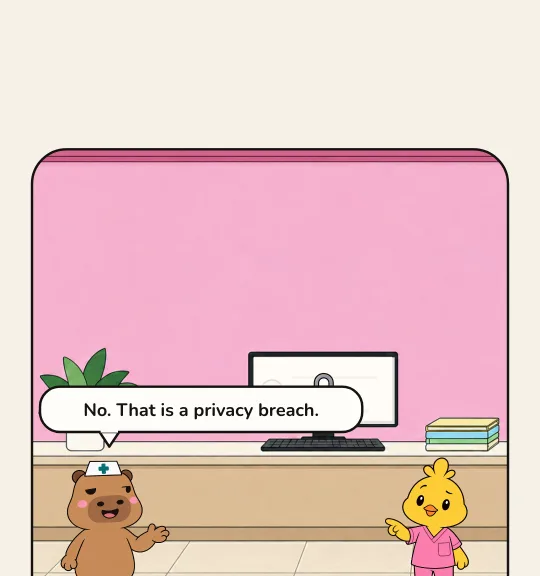
Your neighbour was admitted to your unit last night, in another nurse's care, and a colleague asks you to look up what is wrong with him. You may open a record only for a client in your care, and only for what your work needs.
So you say no, and you tell your colleague that looking without a work reason is a privacy breach.
Check before you interpret a consent discussion
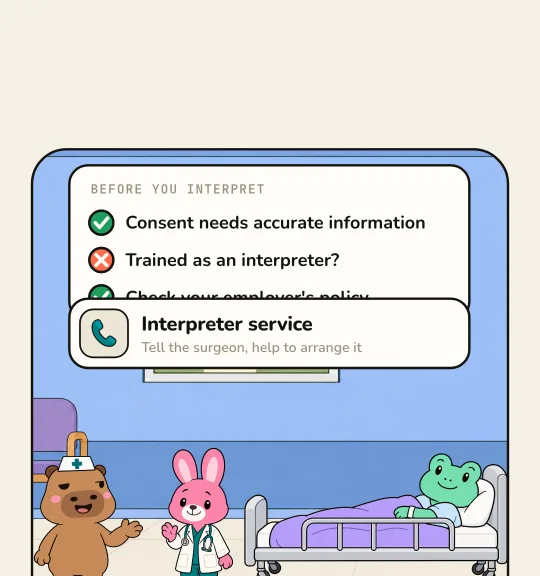
Later a surgeon asks you to interpret a consent discussion for client K, because you speak the client's language at home. Consent needs accurate information, and you have no interpreter training.
So you check your employer's policy, tell the surgeon, and help to arrange the interpreter service.
A capable client has the right to refuse
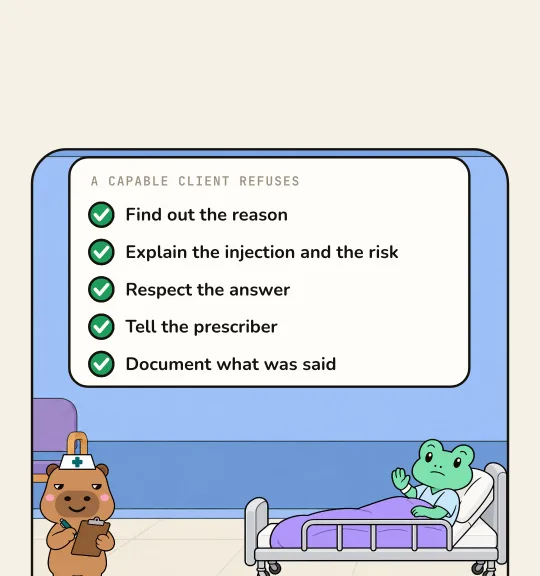
That afternoon, client K refuses an injection that prevents blood clots. A capable client has the legal right to refuse.
- Find out the reason.
- Make sure the client knows what the injection is for, and what refusing may mean.
- Respect the answer.
- Tell the prescriber.
- Document what was said.
A client can ask to see their own record
Now suppose client K asks to read what is written in the chart. A client has the right to ask to see their own record. So you say yes, and you help with the request the way your agency handles it.
Privacy and consent laws differ between provinces. Follow your regulator and your agency's policy.
- College of Nurses of Ontario: Confidentiality and Privacy, Personal Health Information
- College of Nurses of Ontario: Consent
- Ontario: Health Care Consent Act, 1996, sections 4, 10, 11 and 14
- Ontario: Personal Health Information Protection Act, 2004, sections 17 and 52
- British Columbia College of Nurses and Midwives: Nurses, Consent