Mandatory reporting for nurses: when the law overrides confidentiality
Which clients a nurse must report even without consent, who receives the report, and when a capable adult decides. With three examples.
- Confidentiality is the rule. The law lists the exceptions.
- A child who may need protection: reasonable grounds, not proof.
- A capable adult decides, unless a child is at risk.
Confidentiality is the rule, and the law sets a short list of exceptions. A nurse must report a child who may need protection and a listed communicable disease, even without consent. A capable adult who is not on that list decides who is told. This guide follows three clients at a community clinic in one week.
Confidentiality is the rule, with a short list of exceptions
More than one client tells you something and asks you to keep it between the two of you. Each time, you ask one question: does the law require a report?
| Client | Report? | Who receives it |
|---|---|---|
| A child who may need protection | Yes, without delay | Child protection. You call yourself. |
| An adult with a listed communicable disease | Yes | Public health, through your agency's process. |
| A capable adult harmed by a partner, with no child in the home | No | She decides who is told. |
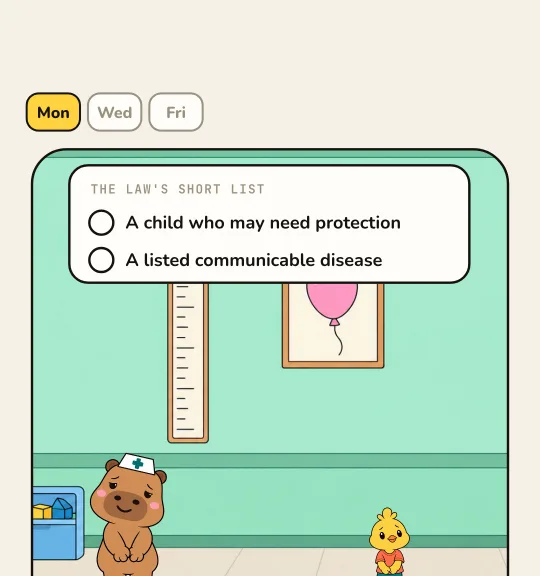
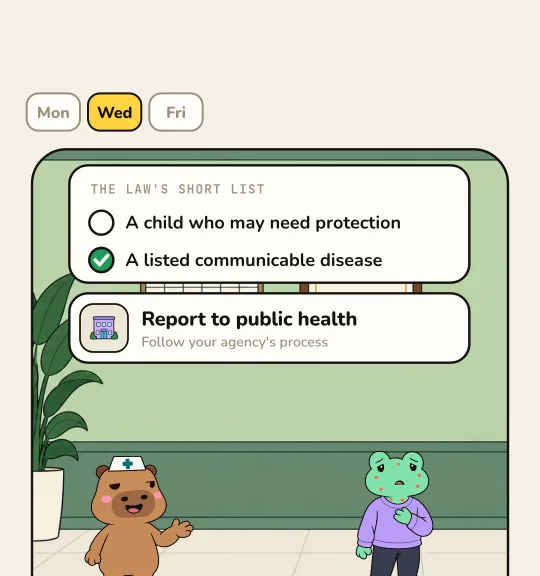
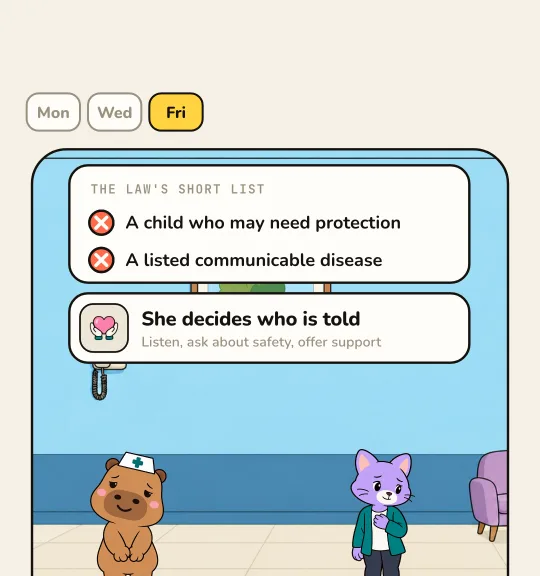
A child who may need protection
On Monday, a four-year-old has bruises on the back and arms, and the explanation does not fit. A child who may need protection is on the list, so you call child protection yourself, without delay.
You need reasonable grounds and not proof. You do not need the parent's consent.
A listed communicable disease
On Wednesday, an adult has confirmed measles and asks you to keep it private. Measles is a listed communicable disease, so public health receives the report. You follow your agency's process, and you tell the client honestly.
A capable adult decides who is told
On Friday, a capable adult tells you that her partner hits her, and asks you to tell no one. No children live in the home. She is a capable adult and no child is at risk, so she decides who is told.
You listen, ask about her safety, offer support services, and document.
Ask the question again when the facts change
Now suppose a child lived in that home. You would ask the question again, because a child who may need protection changes the answer.
Reporting laws differ between provinces. Follow your regulator and your agency's policy.