Equal care and discrimination in nursing: use the client's name and pronouns
A colleague will call a transgender client by the name on her card. What a nurse does at the bedside, at the desk, in the record and at handover.
- Gender identity never changes the care a client is owed.
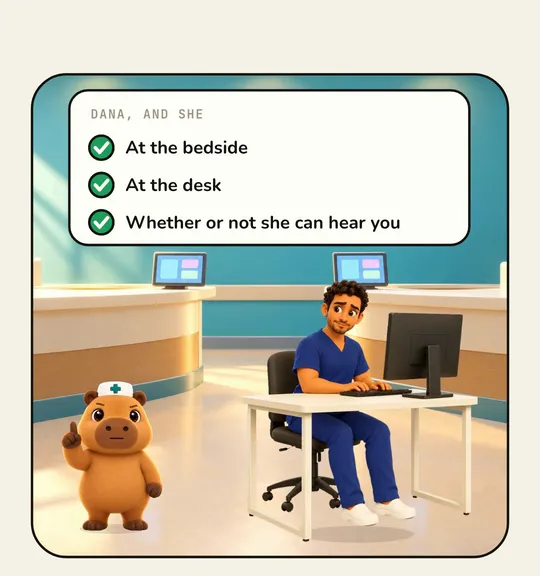
- Use the name and pronouns, whether or not the client can hear you.
- Speak up at the time. If it happens again, go to the charge nurse.
Equal care means that sexual orientation, gender identity and gender expression never change the care a client is owed. You use the name and pronouns the client gives you, every time, and you speak up when a colleague does not. This guide follows one admission.
“I'm just going to call her he”
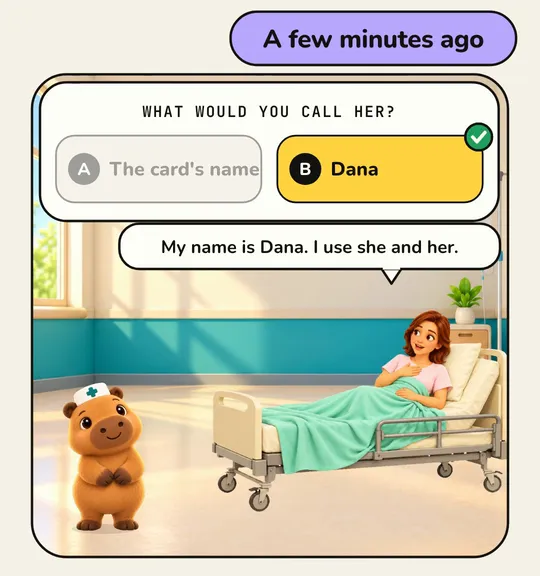
You have just admitted a client with pneumonia. She is a transgender woman, and she told you: “My name is Dana, and I use she and her.” At the desk, a colleague reads her health card and says: “Her health card says a man's name, so I'm just going to call her he.”
Use her name and pronouns everywhere
You call her Dana and you say she, at the bedside and at the desk, whether or not she can hear you.
| Where | What you do |
|---|---|
| The record | Record her name and pronouns where your agency's record has a place for them. |
| Handover | Say her name and pronouns. |
| Identification | Her legal name stays where identification needs it. Tell her why you check it. |
| Her care | Share only what her care needs. Assume nothing about her body, her partner or her family. |
Speak to your colleague
You say it plainly: “Her name is Dana, she uses she and her, and that is what we use here.” Now suppose it happens again tomorrow. Then you take it to the charge nurse.
Start the same way with every client
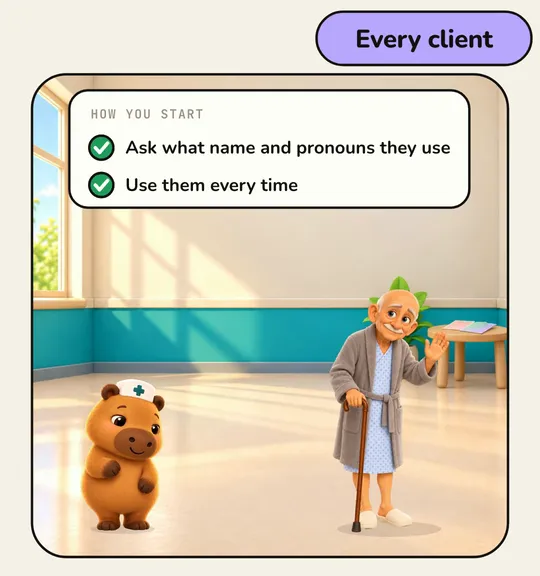
With every client, you ask what name and pronouns they use. Then you use them every time.
Record systems and policies differ between employers. Follow your agency's policy, and see the whole shift in client advocacy and confidentiality in nursing.