Nursing team roles: who does what when a client changes
When a client gets worse, each role on the nursing team owns one part. What the care provider, practical nurse, RN, prescriber and charge nurse do.
- New confusion in an older adult with an infection is a change. Do not wait.
- Each role on the team owns one part of the problem.
- The practical nurse is the link, and checks that each part happened.
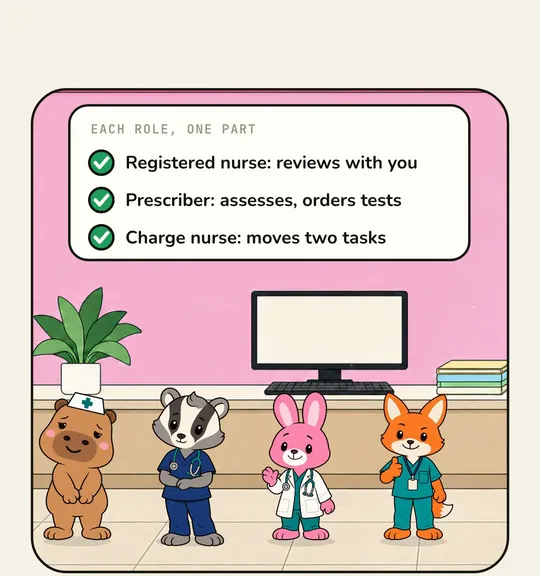
When a client changes, each role on the nursing team owns one part: the care provider observes and reports, the practical nurse assesses and reports, the registered nurse reviews, the prescriber orders, and the charge nurse moves the work. You are the link between them. This guide follows one client through one morning.
“That's normal at her age”: why waiting is the trap
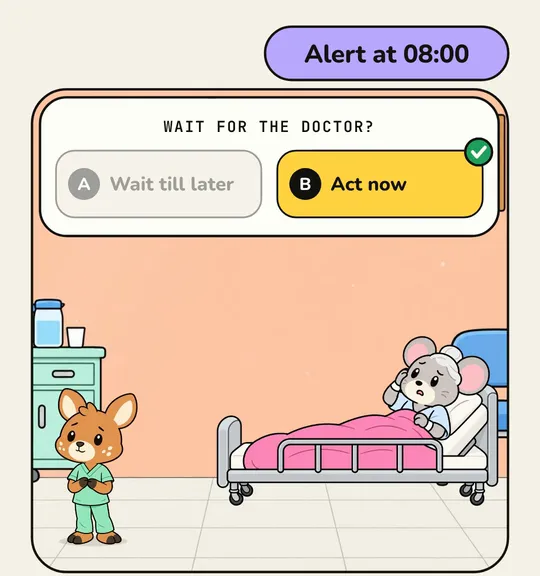
It is 10:30. Client T is 81 and has pneumonia. At 08:00 she was alert and knew where she was. Now your care provider calls you to her room. Client T does not know where she is, and she keeps trying to climb out of bed.
A colleague says, “Confused at her age? That's normal. Leave it till the doctor comes this afternoon.” But new confusion in an older adult with an infection can mean that she is getting worse. So waiting is the trap.
Each role owns one part
A problem like this needs several people. Each role owns one part of it.
| Role | Their part |
|---|---|
| Care provider | Saw the change and called you at once. Stays with client T while you assess. |
| You, the practical nurse | Assess client T against 08:00, make the room safe, and report to the registered nurse at once. |
| Registered nurse | Reviews client T with you, because she is no longer stable or predictable. |
| Prescriber | Assesses client T and orders the tests. |
| Charge nurse | Moves two of your tasks to a colleague. |
Your part: assess, make safe, report
Assess her level of consciousness, her breathing, her oxygen and her vital signs. Compare each one with 08:00. Make the room safe, because she is trying to climb out of bed. Then report to the registered nurse at once.
Client T is no longer stable or predictable, so the registered nurse reviews her with you. You agree who calls the prescriber.
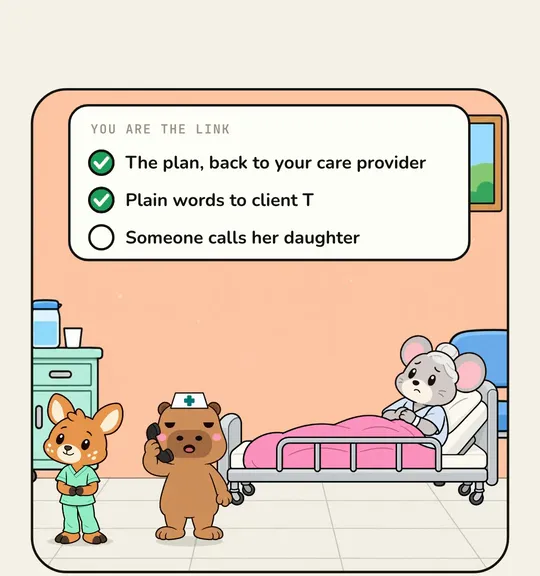
Be the link
- Bring the plan back to your care provider, with what to report to you at once.
- Tell client T what is happening, in short, plain words.
- Make sure that someone calls the daughter she named.
At 11:30, check. Is client T safe, and did each part happen?
Roles differ between provinces and between employers. Follow your regulator's standards and your agency's policy. For the full shift, read six shortcuts to refuse.